

Should You Choose an Electric Car or a Petrol Car in 2026? What e-VED Could Mean for Your Next Lease
Share on:
.jpeg)
The Government’s confirmation that electric vehicles are expected to move to a pay-per-mile charging system from April 2028 has prompted a new question among drivers
If electric cars will soon be charged by the mile, is it still worth choosing an EV now — or would a petrol car be the safer option?
The short answer is that an electric car could still be the better choice for many drivers, particularly if you can charge at home, have access to affordable workplace charging or are considering an EV through a business or salary sacrifice scheme.
The proposed Electric Vehicle Excise Duty, often referred to as e-VED, changes the long-term cost calculation, but it does not automatically remove the financial advantages of driving electric. For people taking out a new three-year lease in 2026, there is another important consideration: e-VED is not expected to begin until April 2028, meaning that it may only affect the final part of the agreement.
So, should you choose electric or petrol? The answer depends less on the future tax alone and more on how, where and how far you drive.
What is e-VED and when is it expected to start?
The proposed e-VED system is intended to introduce a mileage-based charge for electric and plug-in hybrid vehicles from April 2028.
Although some details are still to be finalised, the proposed rate for a fully electric car has been reported as 3p per mile. A driver covering 10,000 miles a year could therefore pay approximately:
10,000 miles × 3p = £300 per year
That is equivalent to around:
£25 per month
However, e-VED is expected to start in April 2028 — not immediately. If you take out a three-year lease during 2026, the new charge may not begin until approximately halfway through the agreement.
That means the effect over the full lease could be considerably lower than simply adding £25 to every monthly payment from day one.
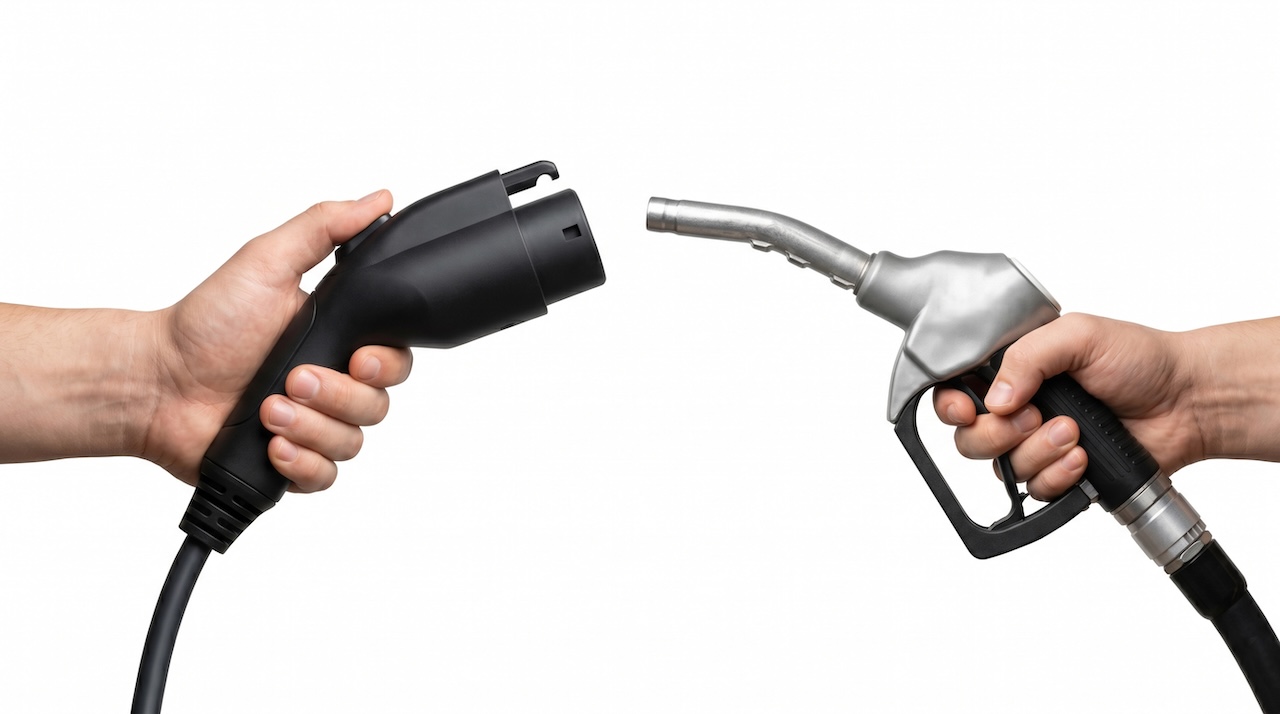
Will e-VED be included in an electric car lease?
At present, the final arrangements for leased vehicles have not been confirmed.
Vehicle Excise Duty, often called road tax or RFL, is already commonly included in many contract hire rentals. It would therefore be reasonable to expect leasing companies and finance providers to develop a way of collecting or incorporating e-VED into future agreements.
For a 10,000-mile-per-year contract, a 3p-per-mile charge would equate to approximately £300 per year. If a leasing company chose to spread that cost across a full agreement, it could potentially add around £25 per month to the rental once e-VED applies.
However, because the charge is based on actual mileage, the final approach could be more complicated. Leasing companies may use mileage allowances, annual adjustments or another method that has yet to be announced.
For anyone taking a lease before April 2028, the important question is likely to be:
Will e-VED be included in my monthly rental, charged separately or adjusted according to the mileage I actually drive?
NEV Leasing will continue to monitor the Government’s guidance and the approach taken by vehicle finance providers as more information becomes available.
Electric versus petrol: an updated running-cost comparison
The cost difference between an electric and petrol car depends heavily on where the EV is charged.
For illustration, consider a driver covering 10,000 miles a year.
Petrol car
Assume:
- 45mpg
- Petrol at approximately £1.45 per litre
- Annual mileage of 10,000 miles
The fuel cost could be approximately:
£1,450 to £1,500 per year
This figure will change as petrol prices and real-world fuel economy change.
Electric car charged mainly at home
Assume:
- Electricity consumption of approximately 3.5 miles per kWh
- Most charging completed at home
- An effective electricity cost of approximately 10p per kWh using an off-peak EV tariff
The annual electricity cost could be approximately:
£285 to £300 per year
If e-VED is introduced at 3p per mile, add:
Approximately £300 per year
Estimated combined electricity and e-VED cost:
Approximately £585 to £600 per year
Even after allowing for the proposed mileage charge, home charging could leave the EV several hundred pounds cheaper to power each year than a comparable petrol car.
Electric car using a mixture of home and public charging
Many EV drivers use a combination of home, workplace and public charging.
Depending on the proportion of charging completed away from home, annual energy costs could be higher. Even so, an EV may still offer a useful saving compared with petrol — particularly if most charging is completed at home or at a lower-cost workplace charger.
Electric car relying mainly on rapid public charging
This is where the calculation becomes less clear.
Rapid and ultra-rapid public charging can be considerably more expensive than charging at home. If most of your charging is completed at premium public charging rates, the energy-cost advantage over petrol may be small or may disappear altogether.
In that situation, the decision may depend more on:
- The monthly lease rental
- Insurance costs
- The availability of convenient charging
- The vehicle’s range
- Your expected mileage
- The driving experience and technology you prefer
Does e-VED make a petrol car the better choice?
Not necessarily.
The proposed e-VED charge should be viewed alongside the costs already paid by petrol drivers.
Petrol prices include fuel duty and VAT, meaning that drivers of petrol cars already contribute significant tax every time they fill up. Electric vehicles use less or no petrol, so the Government is seeking a different way to collect revenue as more vehicles move away from fossil fuels.
The key question is not simply:
“Will electric cars be taxed?”
They already pay Vehicle Excise Duty in many circumstances, and e-VED would add another cost.
The more useful question is:
“After electricity, e-VED, lease costs and other running expenses, which vehicle is likely to cost me less?”
For drivers who can charge cheaply at home, the answer may still be electric.
Should I lease an electric car now if e-VED starts in 2028?
For many drivers, leasing may actually be a sensible way to move to electric during a period of changing technology and taxation.
A lease provides a fixed agreement term and can reduce concerns about future resale values. At the end of the contract, you can review the latest EV technology, charging infrastructure and tax rules before choosing your next vehicle.
If you start a three-year lease in 2026:
- You could have around 18 months without e-VED
- The charge may only affect the latter part of the agreement
- The total impact over the full lease may be lower than £25 per month
- You may benefit from lower electricity costs during the entire agreement
- You will not need to predict the vehicle’s future resale value
Of course, the exact dates depend on when the vehicle is delivered and when the lease begins.
When an electric car is likely to make sense
An EV may be the stronger choice if you:
- Have off-street parking and can install a home charger
- Can use a low-cost overnight electricity tariff
- Drive a regular daily mileage
- Have access to workplace charging
- Mainly make journeys within the vehicle’s real-world range
- Want lower energy and maintenance costs
- Are leasing and prefer not to take the risk of future depreciation
- Are choosing a company car and may benefit from favourable Benefit-in-Kind tax treatment
For these drivers, the proposed e-VED charge may reduce the financial advantage of an EV but may not eliminate it.
When petrol may still be the better choice
A petrol car may remain more suitable if you:
- Cannot charge at home or at work
- Would depend almost entirely on expensive rapid public charging
- Frequently drive long distances without convenient charging stops
- Need maximum flexibility for unpredictable journeys
- Are choosing between a low-cost petrol lease and a significantly more expensive EV
- Prefer a familiar refuelling experience and do not want to plan charging around longer journeys
There is no single answer that applies to every driver.
Electric or petrol: our conclusion
The arrival of e-VED in April 2028 is a reason to review the numbers carefully, but it is not necessarily a reason to abandon electric cars.
For a driver covering 10,000 miles a year, the proposed charge of 3p per mile would equate to approximately £300 a year, or £25 a month once it applies. However, someone taking a three-year lease in 2026 may only be affected during the latter part of the agreement.
If you can charge at home on a competitive electricity tariff, an electric car could still be substantially cheaper to power than a comparable petrol vehicle — even after allowing for e-VED.
If you rely mainly on rapid public charging, the financial case is less certain and a petrol or hybrid vehicle may be more competitive.
Our view is simple:
Do not choose petrol solely because e-VED is coming. Compare the complete cost of the vehicle you are considering, including the lease rental, charging or fuel costs, expected mileage and the way you will use it.
For many drivers, an EV will still be the right choice. For others, particularly those without convenient or affordable charging, petrol or hybrid may remain the more practical option.
The best vehicle is not necessarily the one with the lowest advertised monthly payment. It is the one that suits your mileage, charging access, budget and driving needs.
Compare electric and petrol lease offers
If you are deciding between an electric and petrol vehicle, NEV Leasing can help you compare suitable options and understand the likely monthly and running costs.
If you are unsure which way to go, speak to the NEV Leasing team. We can help you compare vehicles based on your expected mileage, budget and access to charging rather than simply recommending one type of powertrain.




![HYUNDAI I10 1.0 [63] Premium 5dr [Nav]](https://cdn.automotus.uk/store/CVD/car/104620/front_view/i10-hatch-hyi0-25.jpg)